What Is a PID System?
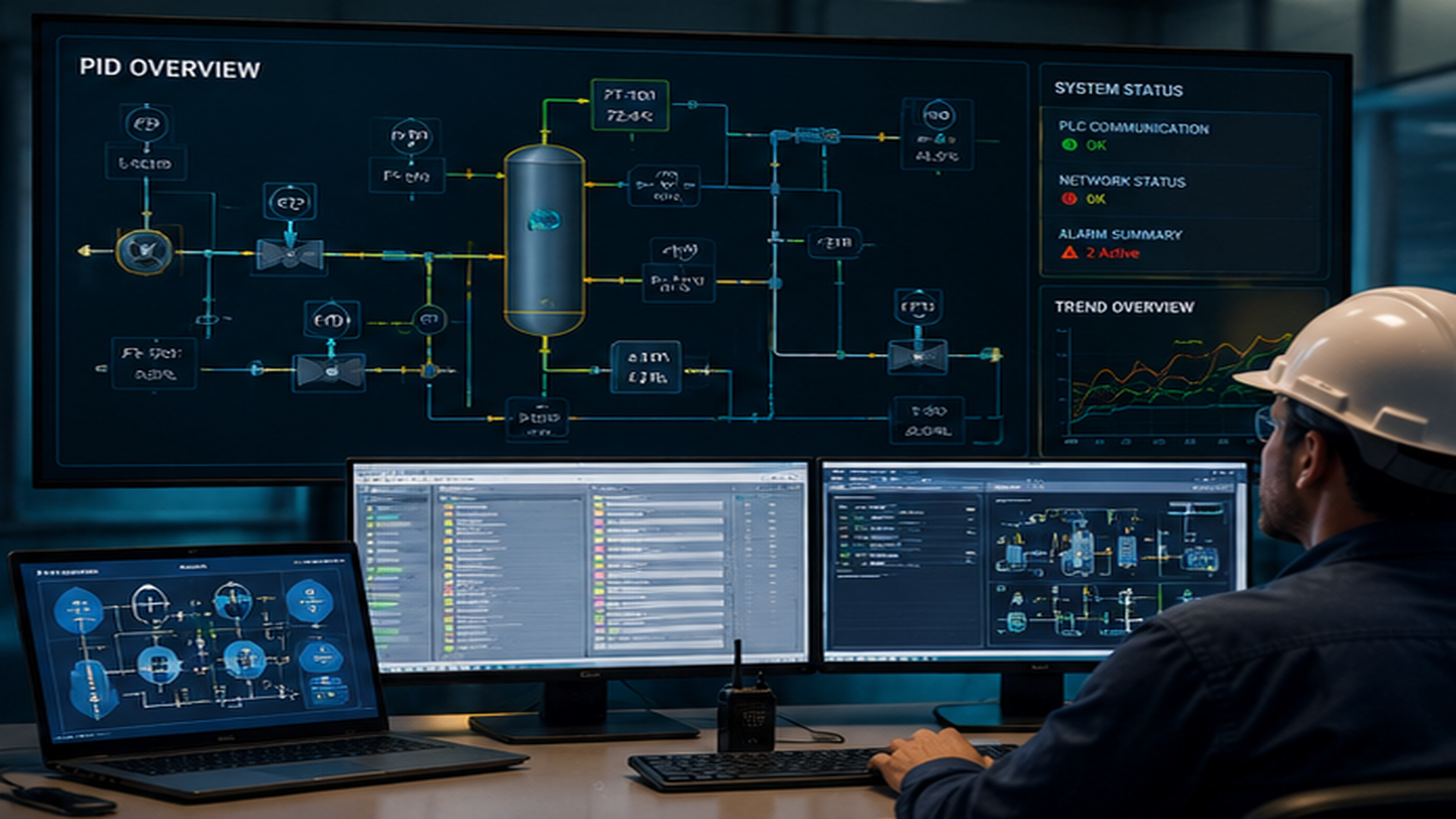
A PID controller — Proportional-Integral-Derivative controller — is the most widely used feedback control mechanism in industrial automation. It continuously measures a process variable (temperature, pressure, flow, level), compares it to a desired setpoint, and calculates a corrective output to close the gap between where the process is and where it should be.
PID controllers are not exotic technology. They are the operational backbone of almost every automated industrial process — which means that technicians who cannot understand, troubleshoot, and tune them are operating with a fundamental competency gap.
The Three Components Explained
| PID Component | Function | What Happens Without It |
| Proportional (P) | Produces an output proportional to the current error magnitude | Process responds but never fully corrects to setpoint |
| Integral (I) | Accumulates past error to eliminate steady-state offset | Process stabilizes near setpoint but never reaches it exactly |
| Derivative (D) | Responds to the rate of change of error to dampen overshoot | Process overshoots setpoint and oscillates before settling |
Why PID Controllers Are Used in Industry
- Stability: PID control maintains process variables within tight tolerance bands even as operating conditions change.
- Precision: Continuous feedback correction achieves process accuracy that open-loop control cannot match.
- Process optimization: Well-tuned PID loops reduce energy consumption, waste, and product variability simultaneously.
- Safety: Rapid corrective response prevents process excursions that could cause equipment damage or safety events.
Real Industrial Examples of PID Systems
- HVAC systems: Maintaining building temperature within a setpoint band despite changing outdoor conditions and occupancy loads.
- Boilers: Controlling steam pressure and temperature across varying load demands.
- Turbines: Managing speed and load output in power generation applications.
- Water treatment systems: Maintaining chemical dosing rates proportional to flow and contamination levels.
- Manufacturing process lines: Controlling tension, temperature, speed, and pressure in continuous production processes.
Common PID Tuning Problems
| Problem | Symptom |
Likely Cause |
|
Overshooting |
Process exceeds setpoint before correcting | P gain too high; D contribution too low |
|
Oscillation |
Process continuously cycles above and below setpoint |
I gain too aggressive; P and D unbalanced |
|
Slow response |
Process takes too long to reach setpoint after a disturbance |
P gain too low; I too slow |
| Offset | Process stabilizes at a point consistently offset from setpoint |
Insufficient I action |
How Technicians Learn PID Systems
- Simulations: Software-based process simulators that allow tuning practice without risking live equipment.
- Instrumentation labs: Hands-on work with real control hardware in a training environment.
- Troubleshooting exercises: Fault injection scenarios that require diagnosis of specific PID performance failures.
- Live system observation: Supervised interaction with production control loops to build practical intuition alongside theory.
TTS supports industrial automation workforce development through hands-on technical training, simulations, and operational readiness programs. Building genuine PID competency — not just awareness — requires the combination of conceptual understanding and practical application that classroom instruction alone cannot provide.
Frequently Asked Questions
What is a PID system?
A feedback control mechanism that continuously measures a process variable, compares it to a setpoint, and calculates a corrective output using Proportional, Integral, and Derivative terms.
Where are PID controllers used?
In virtually every automated industrial process — HVAC, boilers, turbines, water treatment, chemical processing, and continuous manufacturing lines.
Why are PID systems important in automation?
Because they maintain process stability, precision, and safety in the face of continuously changing operating conditions — without constant manual intervention.
How do technicians learn PID troubleshooting?
Through simulations, instrumentation lab work, fault-injection exercises, and supervised interaction with live control loops in production environments.