Understanding a Workforce Assessment
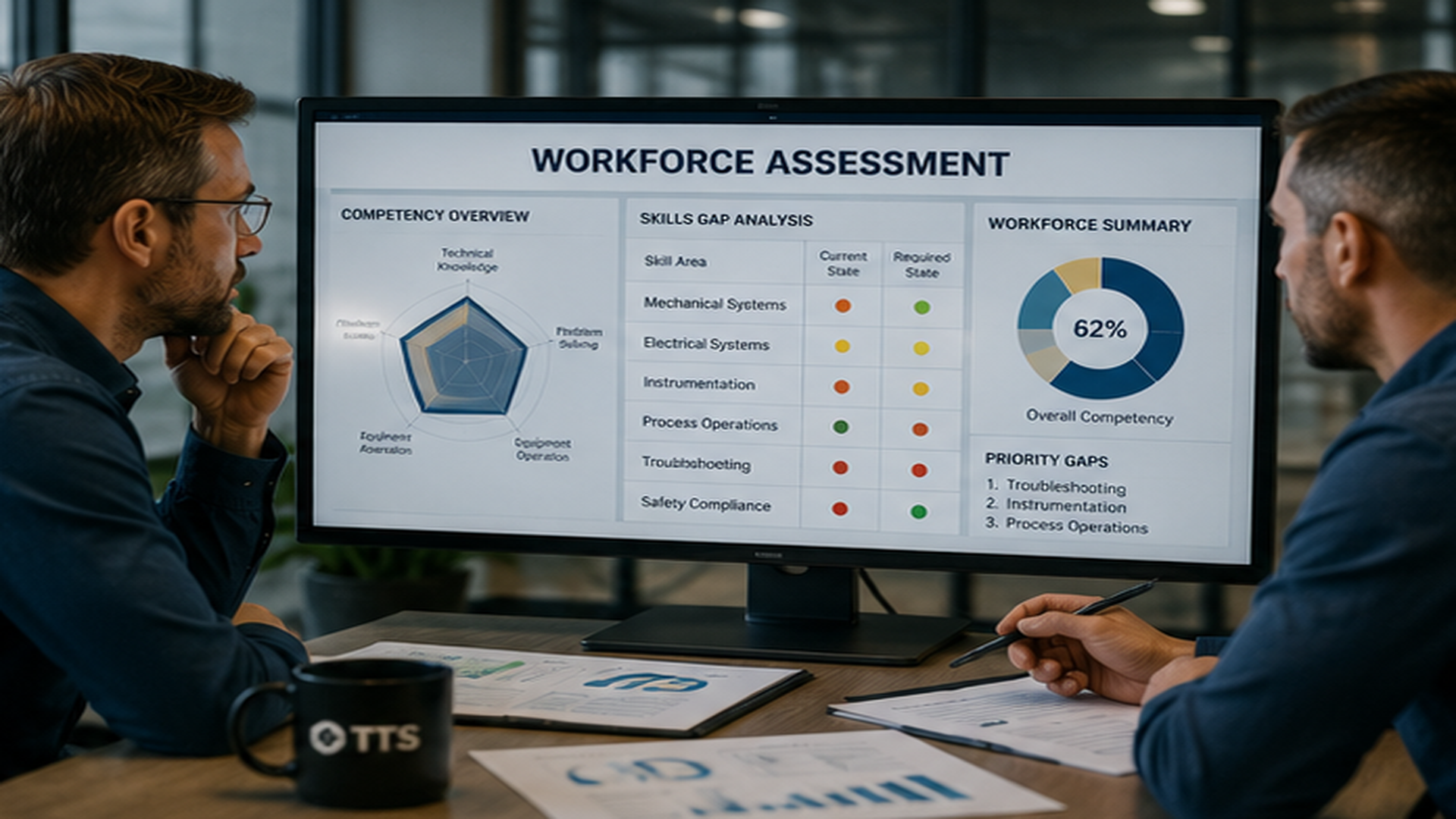
A technical workforce assessment is a structured evaluation of an industrial workforce’s current knowledge, skills, and performance capability against the requirements of their roles. The output is not a training catalog — it is a prioritized gap analysis that connects specific workforce deficiencies to specific operational risks.
TTS supports industrial organizations through structured workforce assessments aligned with operational goals, equipment requirements, and workforce readiness initiatives. The distinction between a generic training needs analysis and a technical workforce assessment is precision: which person, in which role, is deficient in which specific competency, and what is the operational consequence?
Common Workforce Challenges in Industrial Facilities
- Aging workforce with knowledge that has never been formally documented or transferred.
- Knowledge transfer gaps created by retirements that occur faster than succession plans account for.
- Inconsistent training — different operators performing the same task in fundamentally different ways.
- Startup readiness issues where new hires reach the floor before they are technically qualified.
Technical Workforce Assessment Measurements
| Assessment Area | What It Measures | Operational Impact If Gap Exists |
| Technical competency | Knowledge of process principles and equipment systems | Increased downtime and startup delays |
| SOP familiarity | Accuracy and consistency of procedure adherence | Process variation and quality defects |
| Equipment knowledge | Familiarity with specific installed assets | Longer MTTR and repeat failures |
| Troubleshooting capability | Diagnostic logic for abnormal conditions | Escalation dependency and extended downtime |
| Safety readiness | LOTO, emergency response, and hazard recognition | Compliance exposure and incident risk |
Components of an Effective Workforce Assessment
- Skills matrix: Maps each role to its required competency elements with proficiency level definitions.
- Task validation: Practical observation of workers performing actual job tasks, not just written testing.
- Knowledge testing: Written or digital assessment of technical and procedural knowledge.
- Supervisory input: Structured interviews with frontline supervisors about team performance patterns.
Example: Assessing Maintenance Teams in a Multi-Site Facility
A chemical processing company with four facilities identified significant performance variation across its maintenance teams. Some sites consistently met MTTR targets; others did not. A technical workforce assessment revealed that the variation was not equipment or process related — it was competency related. Technicians at the underperforming sites lacked specific training on two installed equipment types that accounted for 68% of unplanned downtime.
Targeting training to those specific gaps — rather than deploying a broad maintenance curriculum — closed the performance gap within two quarters.
Frequently Asked Questions
What is a technical workforce assessment?
A structured evaluation of industrial workforce knowledge and skills against role requirements, producing a prioritized gap analysis tied to operational risk.
How do industrial companies identify skills gaps?
Through skills matrix mapping, practical task observation, knowledge testing, and comparison of team performance data across sites or shifts.
What should be included in a workforce assessment?
Skills matrix, task validation, knowledge testing, supervisory input, and alignment to specific equipment and process requirements.
How often should workforce assessments be conducted?
At minimum annually, and immediately following significant workforce changes — new facility startup, major equipment replacement, or significant turnover in critical roles.