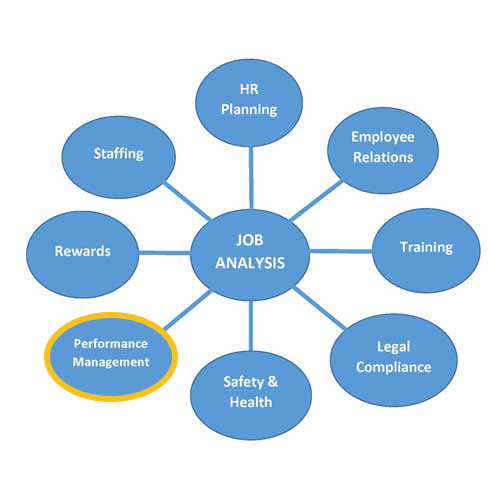
Performance management is a process by which managers and employees work together to plan, monitor, and review an employee’s work objectives and overall contribution to the organization.
Job analysis data can help identify and establish a person’s performance standards.
Job performance measures can be developed and evaluated with an understanding of the assigned duties at the prescribed level of job/task performance.
The job description and performance standards that flow from a job analysis provides a common framework for employees and supervisors to assess work performance.
- Effective management needs feedback and communication with employees
- Performance standards can be developed
- Evaluation criteria is identified
- Appraisal methods identified and forms for appraisal are developed
A common misconception of equating “performance management” with “performance appraisal” is often made.
Performance management refers to the processes, programs, and activities that organizations apply to manage the performance of individual employees, teams, departments, and other business units.
Performance appraisal is the act of appraising or evaluating performance during a given period to determine how good (or bad) an employee has performed relative to objectives or goals. “Performance appraisal” is one of many different activities within the overall term “performance management.”
Contact Bill Salter today at wsalter@techtransfer.com and learn how we can help your organization!