- Do you know what training your people need?
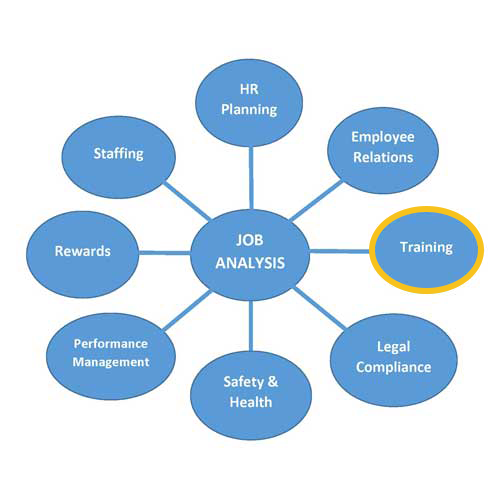
In last week’s article, we talked about how JTA data can be used for STAFFING. So, now that we have a good job description (that was developed from the task list), we’ll talk about HOW you can use JTA data to identify the proper training employees need for a successful job performance.
- How do I know which tasks to select for training and what type of training?
When deciding which tasks to train, two guiding factors must be used: effectiveness and efficiency. Seek the best program within acceptable costs while meeting the learning intent. Often, it helps to select tasks for training by dividing them into three groups:
- Those tasks that are to be included in a formal learning program
- Those tasks that are to be included in On-the-Job-Training (OJT)
- Those tasks for which no formal or OJT is needed (i.e., job performance aids or self-study packets)
When selecting tasks for training, consider the following factors:
- Is the training mandated by the Occupational Safety and Health Act?
- Could a job performance aid or self-study packet be used in place of formal training?
- Can people be hired that have already been trained?
- Is training needed to ensure their behavior does not compromise the company’s legal position (i.e. Equal Employment Opportunity, labor relations laws, or state laws)?
- What will happen if you do not train this task?
- What will be the benefits if you do train this task?
- If you don’t train it, how will the employee learn it?
- How will this training help to achieve your goals?
Below are questions to ask when performing a Job/Task Analysis:
- How difficult or complex is the task?
- What behaviors are used in the performance of the job?
- How frequently is the task performed?
- How critical is the task to the performance of the job?
- To what degree is the task performed individually, or is part of a set of collective tasks?
- If it is a subset of a set of collective tasks, what is the relationship between the various tasks?
- What is the consequence if the task is performed incorrectly or not performed at all?
- To what extent can the task be trained on the job?
- What level of task proficiency is expected following training?
- How critical is the task?
- What information is needed to perform the task? What is the source of information?
- What are the performance requirements?
- Does execution of the task require coordination between other personnel or with other tasks?
- Are the demands (perceptual, cognitive, psychomotor or physical) imposed by the task excessive?
- How often is the task performed during a specified time frame (i.e., daily, weekly, monthly, yearly)?
- How much time is needed to perform this task?
- What prerequisite skills, knowledge, and abilities are required to perform the task?
- What is the current criteria for acceptable performance? What is the desired criteria?
- What behaviors distinguish good performers from poor performers?
- What behaviors are critical to the performance of the task?
Stay tuned for next week’s topic on how JTA data is useful for LEGAL COMPLIANCE.
Contact Bill Salter today at wsalter@techtransfer.com and see what we can do for you!